Sunday, April 16, 2017
How to Customize Pen Drive as Ram Memory in Windows 7
How to Customize Pen Drive as Ram Memory in Windows 7
Programs that require lots of memory may not run smoothly , if your PC has a low memory. To avoid this make your pen drive/USB of large size as RAM, which will make your system faster. It can be possible with any kind of Windows operating system, all you need is a pen drive of minimum 1GB memory ,better to prefer 4GB.To know how to do this, follow below steps.

1.Format your Pen Drive first
2.. Insert the Pen Drive with 1GB at least in the USB port, Wait for the PC to detect the pen drive.
3. Right click on My Computer--> Properties.
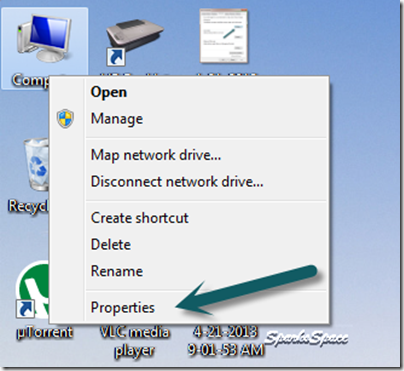
4. Select Advanced System Settings.

5. Select Advanced—> Performance –>Settings

6. Under Performance Options Select Advanced –>Virtual memory Change

7. Uncheck Automatically manage paging file size for all drives Click on Custom Size.Select your Pen Drive . Enter the same in the Initial and Max columns in the Custom Size .The size depends upon your free memory capacity of your pen drive. So you can change this limit according to your pen drive size.

8. Click on Set button, then click on OK.

9. Now restart your PC.Finally check the general start up time and also speed of your PC.This trick will surely improve the performance of your computer and increase operational speed in low cost.
Available link for download

Sunday, January 8, 2017
How RAM Works
How RAM Works
 , a memory chip is an integrated circuit (IC) made of millions of transistors and capacitors. In the most common form of computer memory, dynamic random access memory (DRAM), a transistor and a capacitor are paired to create a memory cell, which represents a single bit of data. The capacitor holds the bit of information -- a 0 or a 1 (see How Bits and Bytes Work for information on bits). The transistor acts as a switch that lets the control circuitry on the memory chip read the capacitor or change
 Static RAM
 or plugged into a socket that was soldered on the motherboard. This method worked fine when computers typically operated on a couple of megabytes or less of RAM, but as the need for memory grew, the number of chips needing space on the motherboard increased. (DIP). This pin configuration could be soldered into holes on the computers
 Types of RAM
- SRAM: Static random access memory uses multiple transistors, typically four to six, for each memory cell but doesnt have a capacitor in each cell. It is used primarily for cache.
- DRAM: Dynamic random access memory has memory cells with a paired transistor and capacitor requiring constant refreshing.
- FPM DRAM: Fast page mode dynamic random access memory was the original form of DRAM. It waits through the entire process of locating a bit of data by column and row and then reading the bit before it starts on the next bit. Maximum transfer rate to L2 cache is approximately 176 MBps.
- EDO DRAM: Extended data-out dynamic random access memory does not wait for all of the processing of the first bit before continuing to the next one. As soon as the address of the first bit is located, EDO DRAM begins looking for the next bit. It is about five percent faster than FPM. Maximum transfer rate to L2 cache is approximately 264 MBps.
- SDRAM: Synchronous dynamic random access memory takes advantage of the burst mode concept to greatly improve performance. It does this by staying on the row containing the requested bit and moving rapidly through the columns, reading each bit as it goes. The idea is that most of the time the data needed by the CPU will be in sequence. SDRAM is about five percent faster than EDO RAM and is the most common form in desktops today. Maximum transfer rate to L2 cache is approximately 528 MBps.
- DDR SDRAM: Double data rate synchronous dynamic RAM is just like SDRAM except that is has higher bandwidth, meaning greater speed. Maximum transfer rate to L2 cache is approximately 1,064 MBps (for DDR SDRAM 133 MHZ).
- RDRAM: Rambus dynamic random access memory is a radical departure from the previous DRAM architecture. Designed by Rambus
, RDRAM uses a Rambus in-line memory module (RIMM), which is similar in size and pin configuration to a standard DIMM. What makes RDRAM so different is its use of a special high-speed data bus called the Rambus channel. RDRAM memory chips work in parallel to achieve a data rate of 800 MHz, or 1,600 MBps. Since they operate at such high speeds, they generate much more heat than other types of chips. To help dissipate the excess heat Rambus chips are fitted with a heat spreader, which looks like a long thin wafer. Just like there are smaller versions of DIMMs, there are also SO-RIMMs, designed for notebook computers.
- Credit Card Memory: Credit card memory is a proprietary self-contained DRAM memory module that plugs into a special slot for use in notebook computers.
- PCMCIA Memory Card: Another self-contained DRAM module for notebooks, cards of this type are not proprietary and should work with any notebook computer whose system bus matches the memory cards configuration.
- CMOS RAM: CMOS RAM is a term for the small amount of memory used by your computer and some other devices to remember things like hard disk settings -- see Why does my computer need a battery? for details. This memory uses a small battery to provide it with the power it needs to maintain the memory contents.
- VRAM: VideoRAM, also known as multiport dynamic random access memoryvideo adapters or 3-D accelerators. The "multiport" part comes from the fact that VRAM normally has two independent access ports instead of one, allowing the CPU and graphics processor to access the RAM simultaneously. VRAM is located on the graphics card and comes in a variety of formats, many of which are proprietary. The amount of VRAM is a determining factor in the resolution and color depth of the display. VRAM is also used to hold graphics-specific information such as 3-D geometry data SGRAM (synchronous graphics RAM) instead. Performance is nearly the same, but SGRAM is cheaper. (MPDRAM), is a type of RAM used specifically for and texture maps. True multiport VRAM tends to be expensive, so today, many graphics cards use
Memory Modules


 has evolved over the past few years. The first types were proprietary, meaning that different computer manufacturers developed memory boards that would only work with their specific systems. Then came SIMM, which stands for single in-line memory module. This memory board used a 30-pin connector and was about 3.5 x .75 inches in size (about 9 x 2 cm). In most computers, you had to install SIMMs in pairs of equal capacity and speed. This is because the width of the bus is more than a single SIMM. For example, you would install two 8-megabyte (MB) SIMMs to get 16 megabytes total RAM. Each SIMM could send 8 bits of data at one time, while the system bus could handle 16 bits at a time. Later SIMM boards, slightly larger at 4.25 x 1 inch (about 11 x 2.5 cm), used a 72-pin connector for increased bandwidth and allowed for up to 256 MB of RAM.
 grew in speed and bandwidth capability, the industry adopted a new standard in dual in-line memory module (DIMM). With a whopping 168-pin or 184-pin connector and a size of 5.4 x 1 inch (about 14 x 2.5 cm), DIMMs range in capacity from 8 MB to 1 GB per module and can be installed singly instead of in pairs. Most PC memory modules and the modules for the Mac G5 systems operate at 2.5 volts, while older Mac G4 systems typically use 3.3 volts. Another standard, Rambus in-line memory module (RIMM), is comparable in size and pin configuration to DIMM but uses a special memory bus to greatly increase speed.
 use proprietary memory modules, but several manufacturers use RAM based on the small outline dual in-line memory module (SODIMM) configuration. SODIMM cards are small, about 2 x 1 inch (5 x 2.5 cm), and have 144 or 200 pins. Capacity ranges from 16 MB to 1 GB per module. To conserve space, the Apple iMac desktop computer uses SODIMMs instead of the traditional DIMMs. Sub-notebook computers use even smaller DIMMs, known as MicroDIMMs, which have either 144 pins or 172 pins.
 not only to detect single bit errors, but actually correct them as well. ECC memory will also detect instances when more than one bit of data in a byte fails. Such failures are very rare, and they are not correctable, even with ECC.
 works happily on a system with only 4 MB of RAM. If you plan to add X-Windows or do much serious work, however, youll probably want 64 MB. Mac OS X systems should have a minimum of 128 MB, or for optimal performance, 512 MB.
  of some sort (Web pages, database, application, FTP or network).
  if you want to do any of the following:
 - Play realistic games
- Capture and edit video
- Create 3-D graphics
- Work in a high-resolution, full-color environment
- Design full-color illustrations


Available link for download
Friday, December 30, 2016
Harga Zenfone 2 Versi RAM 4 GB
Harga Zenfone 2 Versi RAM 4 GB
Sobat blogger, Asus akhirnya merilis empat seri smartphone terbarunya sekaligus. Zenfone 2
Keempat perangkat tersebut hadir dengan bentuk atau desain fisik yang sama. Yang membedakannya hanya terlihat di sisi spesifikasi internal saja.
Keempat perangkat itu juga memiliki kesamaan dari segi prosesor. Yaitu menggunakan prosesor Atom buatan Intel. Meskipun begitu, seri prosesor sedikit berbeda, yakni antara Intel Atom Z3580 atau Intel Atom Z3560.
Yang menjadi perhatian selama ini, tentunya, adalah seri ZE551ML. Ini merupakan seri teratas dengan layar 5,5 inci, RAM 4 GB, dan media penyimpanan 32 GB. Produk tersebut dijual dengan harga 8.990 dollar Taiwan atau setara Rp 3,7 juta.
Produk ini mendapat perhatian begitu besar karena menjadi smartphone pertama yang diumumkan memiliki RAM 4 GB.
Perangkat termurah dari ZenFone 2 memiliki nama seri ZE500CL. Dengan ukuran layar 5 inci, yang dilengkapi dengan RAM 2 GB dan media penyimpanan internal 16 GB. Produk yang satu ini dilabeli harga 4.990 dollar Taiwan atau sekitar Rp 2 juta.
Sementara itu, versi satu di atasnya, ZE550ML. Perangkat ini memiliki layar 5,5 inci, RAM 2 GB dan media penyimpanan internal 16 GB. Seri ini dijual dengan harga 5.990 dollar Taiwan atau sekitar Rp 2,5 juta.
Keempat produk tersebut nantinya akan hadir dengan kamera utama 13 megapiksel dan kamera depan 5 megapiksel.
Hingga saat ini, masih belum diketahui kapan ZenFone 2 akan dilepas ke pasar Indonesia. Akan tetapi, menurut kabar yang berkembang, Asus sudah akan memasarkan produk ini pada bulan April mendatang di Tanah Air.
Belum ada informasi apakah harga yang dibanderol di Taiwan akan sama dengan pasar Indonesia atau tidak.

Available link for download